“The Patient’s Life Is the Bottom Line”: Dr Rajneesh Kapoor on Mentoring TAVI Teams Across India and Asia
Recorded interview with Dr Rajneesh Kapoor. All quotes are his own words.
Key takeaway: Dr Rajneesh Kapoor, Chairman of Interventional Cardiology at Medanta, has personally proctored or mentored around 70–80 structural heart procedures, including TAVI/TAVR, at hospitals outside Medanta. These include 8–9 cases in Bangladesh and several in Nepal and, most recently, a TAVR proctoring visit to Vietnam on 3 October 2026. He calls this work a privilege, but says the patient’s successful outcome must always be the bottom line.
Considering TAVI? Speak directly to Dr Rajneesh Kapoor
This is Dr Rajneesh Kapoor’s direct number. Chairman, Interventional Cardiology, Medanta – The Medicity, Gurugram.
| Structural heart cases proctored outside Medanta | Around 70–80 |
|---|---|
| Cases proctored in Bangladesh | Around 8–9 |
| Other countries | Nepal (several cases); Vietnam (TAVR proctoring, 3 October 2026) |
What does a TAVI proctor actually do?
TAVI (transcatheter aortic valve implantation, called TAVR in the US) replaces a narrowed aortic valve through a catheter, usually without open-heart surgery. When a hospital starts a TAVI programme, its early cases are typically supervised by an experienced operator, a proctor, who guides patient selection, valve sizing and the procedure itself. Dr Kapoor is one of the structural heart specialists that hospitals in India and South Asia call on for this role, alongside his own TAVR/TAVI practice at Medanta.
In his own words: why he travels to teach
“As a cardiologist and as a structural heart interventional specialist, we are putting a huge effort into proctoring these cases, or mentoring these cases, in outside smaller hospitals. We travel a lot. I have personally done around seventy, eighty cases outside my parent institute.”
That work has crossed borders. He has proctored roughly eight to nine cases in Bangladesh and a few in Nepal, and on 3 October 2026 he travelled to Vietnam as a TAVR mentor and proctor. At his home institute, the same team has taken on demanding work such as five complex TAVI cases in a single week.
Update · 3 October 2026
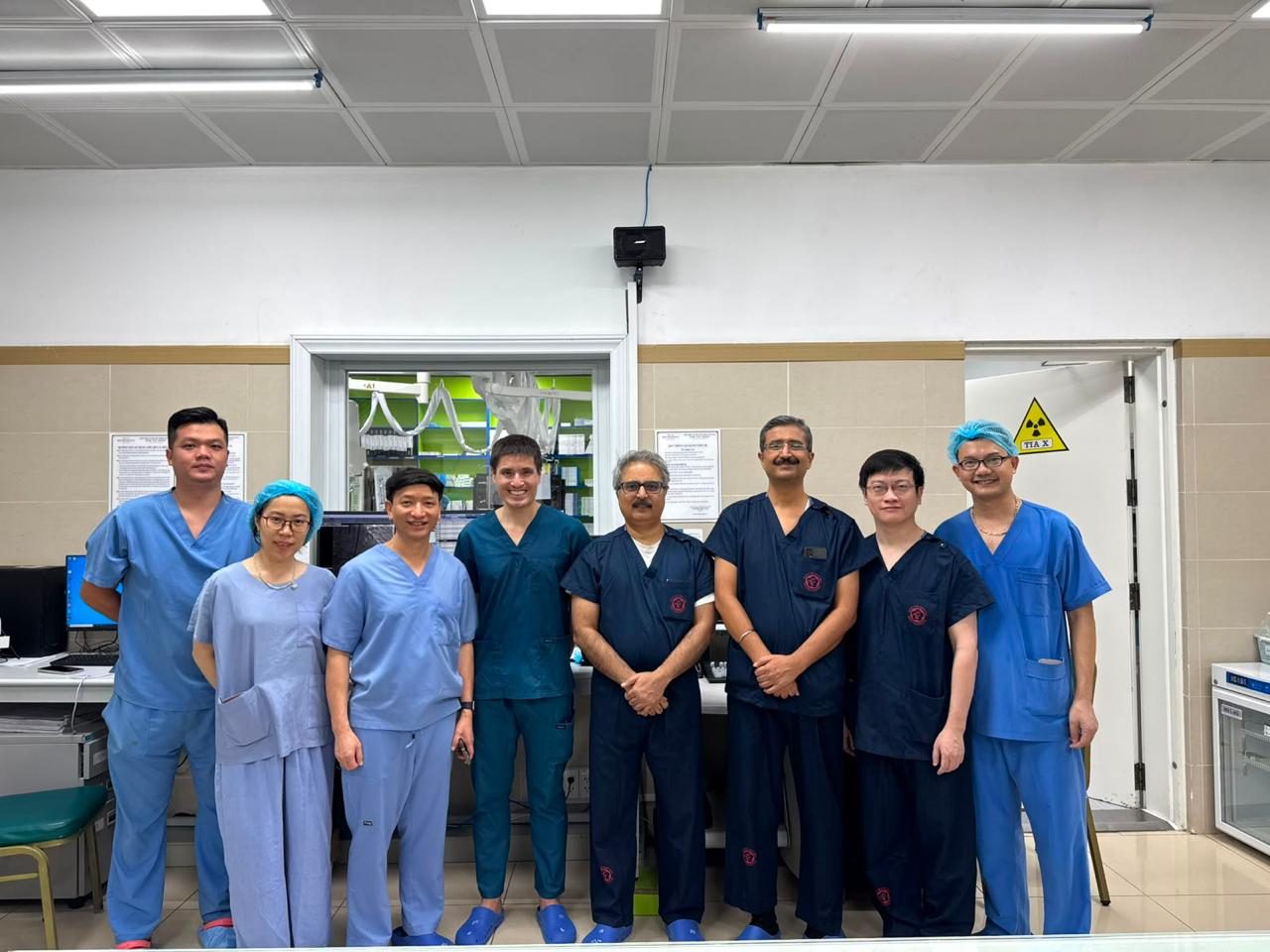
The Vietnam invitation Dr Kapoor mentions in the video has now happened. He visited Vietnam as a mentor and proctor for TAVR, working with the local heart team on the procedure, challenging anatomies and decision-making. Writing about the visit, he said it was gratifying to contribute to “the growth of TAVR programs beyond our own borders”. See his post and photos from Vietnam on LinkedIn.

“I consider all cardiologists my colleagues”
Dr Kapoor frames mentoring as a responsibility that comes with expertise:
“I am very, very passionate about disseminating these procedural skills to my colleagues. I consider all cardiologists as my colleagues. If I am privileged enough that I am leading this professional excellence, and I am expert in these procedures, I should definitely mentor other professional colleagues.”
He accepts these invitations wherever knowledge can be shared, calling it both a privilege and an honour.
The non-negotiable: patient outcome first
For all the emphasis on training, he is clear about what matters most.
“The main thing is the patient’s life, the successful outcome of the procedure to a patient. That should be the bottom line.”
Dr Rajneesh Kapoor, Chairman, Interventional Cardiology, MedantaWhat that outcome means for a family is easier to see in a real case, like Charanjit Singh’s TAVI journey.
Why this matters if you are considering TAVI
- Wider access. Every centre trained under an experienced proctor is one more place where TAVI can be offered closer to a patient’s home, including in smaller cities.
- A fair question to ask. If you are being evaluated for TAVI, ask your hospital about its heart team’s TAVI experience and whether its early cases were proctored. These TAVR answers on eligibility, hospital stay and valve life can help you prepare.
- Expertise at the source. Patients who want to consult the operator who trains other teams can seek an evaluation with Dr Kapoor’s structural heart team at Medanta, Gurugram, or send their reports for review first.
Discuss your TAVI/TAVR evaluation directly with Dr Rajneesh Kapoor
This is Dr Rajneesh Kapoor’s direct number. Chairman, Interventional Cardiology, Medanta – The Medicity, Gurugram.
Dr Kapoor’s research: why younger patients are asking for TAVR
Dr Kapoor’s commitment to the right outcome also shows in his own research. He studied 305 patients with severe aortic stenosis who were evaluated for aortic valve replacement between 2020 and March 2026, and found a sharp rise in younger patients asking for TAVR, often after reading or watching about it online. The findings were reported by The Tribune on 23 July 2026.
| Patients aged 60+ evaluated, 2020–2024 | 93% |
|---|---|
| Patients aged 50–60, 2020–2024 | 5% |
| Patients under 50, 2020–2024 | 1% |
| Patients under 60, 2024–March 2026 | 8–10% (nearly doubled) |
| Patients under 50, change vs previous four years | Nearly seven-fold rise |
| Under-50 patients who first learnt about TAVR online | 98% |
For context, Dr Kapoor notes that aortic stenosis affects roughly 2–3% of people over 65 and about 7% of those over 80, and is projected to almost double worldwide by 2050 as populations age.
His advice to patients is to use the internet to ask better questions of their doctor, not to self-prescribe a procedure. The right treatment, he says, depends on “your age, your anatomy and your risk profile”.
Dr Rajneesh Kapoor in the news
 Lead story on Dr Kapoor’s study of 305 patients showing a rapid rise in under-60 and under-50 patients seeking TAVR, mostly influenced by online information.
 युवा मरीजों में टीएवीआर की बढ़ती मांग पर डॉ. रजनीश कपूर का अध्ययन: 305 मरीजों पर आधारित।
 Dr Kapoor explains MitraClip (TEER), a catheter-based repair for leaking mitral valves in patients not fit for open-heart surgery, and the symptoms to watch for.
Dr Kapoor inaugurated Medanta’s new OPD centre in Chandigarh, bringing super-specialist consultations closer to patients in Punjab, Haryana and nearby states.
Frequently asked questions
How many TAVI/structural heart cases has Dr Rajneesh Kapoor proctored outside Medanta?
Dr Rajneesh Kapoor says he has personally proctored or mentored around 70–80 structural heart cases at hospitals outside his parent institute, Medanta – The Medicity, Gurugram.
Has Dr Rajneesh Kapoor performed or proctored TAVI outside India?
Yes. He has proctored around 8–9 cases in Bangladesh and a few in Nepal. On 3 October 2026 he also mentored and proctored TAVR in Vietnam.
What is TAVI proctoring?
TAVI proctoring is when an experienced structural heart operator supervises and guides a hospital’s team during its early TAVI cases, from patient selection to the procedure. Dr Kapoor travels to smaller hospitals to do this.
Why does Dr Rajneesh Kapoor mentor other cardiologists in TAVI?
He says he is passionate about sharing procedural skills and considers all cardiologists his colleagues. He believes that specialists who lead in a procedure should mentor others, and calls it a privilege and an honour.
What does Dr Rajneesh Kapoor consider most important in a TAVI procedure?
The patient’s life and the successful outcome of the procedure. In his words, that “should be the bottom line”.
Where can I consult Dr Rajneesh Kapoor for TAVI/TAVR?
Dr Rajneesh Kapoor is Chairman of Interventional Cardiology at Medanta – The Medicity, Gurugram. You can reach Dr Rajneesh Kapoor directly on his personal number, +91 99719 91740, by call or WhatsApp. View his Medanta profile or visit tavr-india.com for his TAVR/TAVI patient resources.
What did Dr Rajneesh Kapoor’s study of 305 TAVR patients find?
The study reviewed 305 patients with severe aortic stenosis who were evaluated for aortic valve replacement between 2020 and March 2026. From 2020 to 2024, 93% were aged 60 or above. From 2024 to March 2026, the share of patients under 60 nearly doubled to 8–10%, and patients under 50 rose nearly seven-fold.
Why are younger patients asking for TAVR?
In Dr Kapoor’s study, 98% of patients under 50 first learnt about TAVR from the internet, including social media, video platforms, health websites and online forums, rather than from a referring doctor. Many requested TAVR even when surgery remained the medically indicated treatment for their age.
Is TAVR the right choice for patients under 60?
Not automatically. Dr Kapoor advises that the right treatment depends on your age, your anatomy and your risk profile, and should be decided with a specialist. For some younger patients, open-heart valve surgery remains the medically indicated option.
Does Dr Rajneesh Kapoor treat leaking mitral valves without open-heart surgery?
Yes. He uses MitraClip, a catheter-delivered clip that helps a leaking mitral valve close, in a procedure called transcatheter edge-to-edge repair (TEER). It is designed for patients with mitral regurgitation who are not fit for open-heart surgery.
Full transcript
Read the full transcript
As a cardiologist and as a structural heart interventional specialist, we are putting a huge effort into proctoring these cases, or mentoring these cases, in outside smaller hospitals. We travel a lot. I have personally done around seventy, eighty cases outside my parent institute. I have done almost eight, nine in Bangladesh, a few in Nepal, and I got an invite from Vietnam. I still couldn’t go, but that is in the pipeline.
I am very, very passionate about disseminating these procedural skills to my colleagues. I consider all cardiologists as my colleagues. I feel that if I am privileged enough that I am leading this professional excellence, where I am able to do and I am expert in these procedures, I should definitely mentor other professional colleagues. So I am quite passionate, and I try to accept these invites wherever we can disseminate knowledge. It’s a privilege. It’s an honour. We should definitely look forward.
But finally, one thing should be very clear. The main thing is the patient’s life, the successful outcome of the procedure to a patient. That should be the bottom line.
More from Dr Kapoor on heart valve treatment
- The end of open-heart surgery? Dr Kapoor on the rise of catheter-based valve procedures
- Signs and simple tests to diagnose heart valve disease
- When aortic stenosis can no longer be ignored: line of treatment
Medical disclaimer: This article shares a specialist’s professional perspective and is not a substitute for individual medical advice. Suitability for TAVI is decided by a heart team after evaluation.